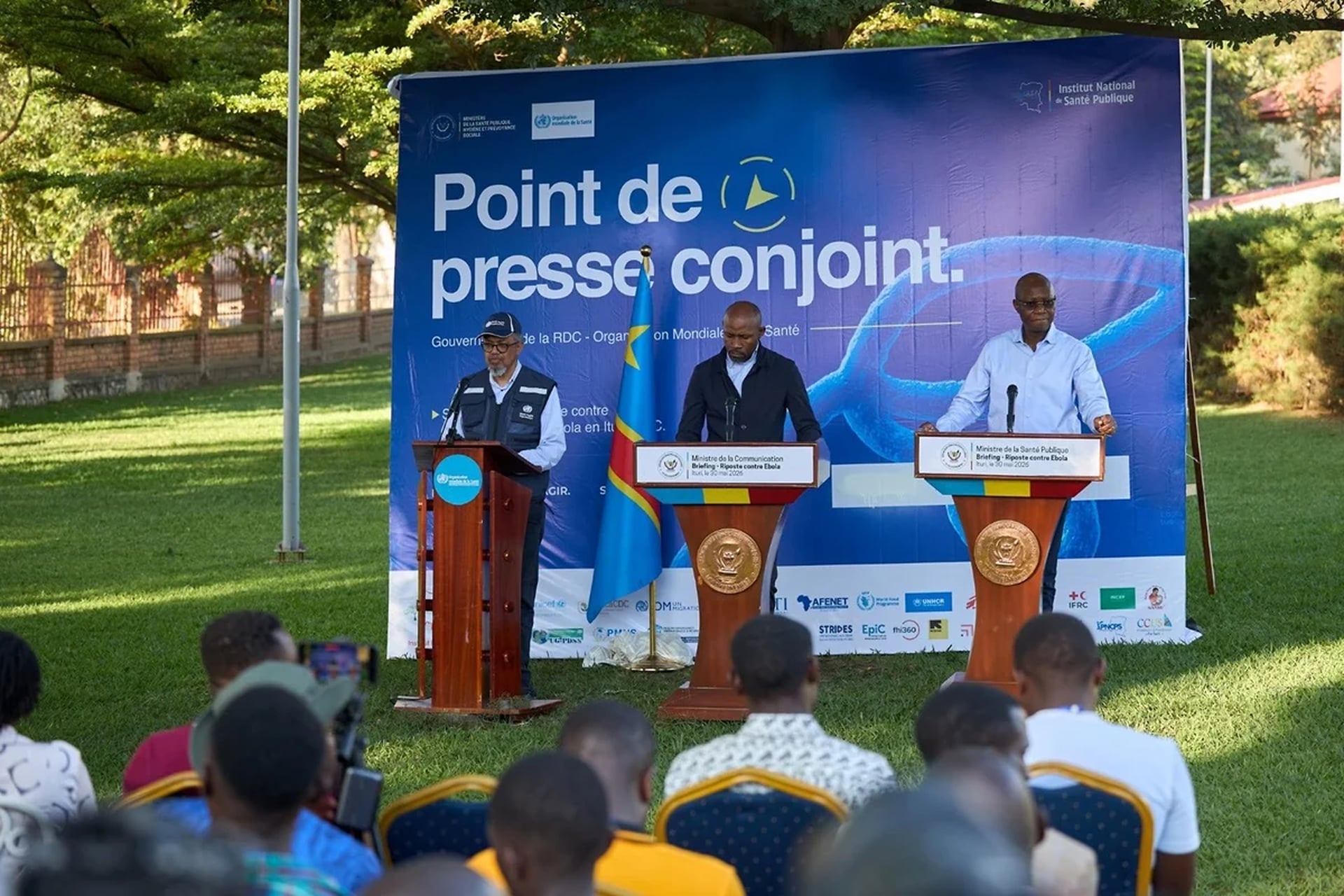
The Democratic Republic of Congo (DRC) and the World Health Organization (WHO) have reinforced their steadfast partnership, launching a comprehensive joint effort to combat a rapidly escalating outbreak of Ebola disease in the nation's eastern provinces. This renewed commitment follows a critical high-level mission to Bunia, Ituri Province, led by prominent figures including Dr. Samuel Roger Kamba, the DRC’s Minister of Health, Mr. Patrick Muyaya Katembwe, Minister of Communication and Medias, and Dr. Tedros Adhanom Ghebreyesus, Director-General of the WHO. Their collective presence underscores the severe challenges posed by the Bundibugyo virus, a strain of Ebola for which no licensed vaccine or specific treatment currently exists, demanding an urgent and coordinated global response.
The current outbreak presents a formidable public health crisis, with the Ministry of Health reporting a rapidly evolving epidemiological landscape. Cases and fatalities have been confirmed across several health zones, primarily concentrated in Ituri, but also extending into neighboring North Kivu and South Kivu provinces. This geographical spread complicates containment efforts, necessitating a multi-pronged strategy that accounts for diverse community structures and logistical hurdles. The Bundibugyo ebolavirus, while less frequently encountered than the Zaire strain, poses unique challenges due to the absence of readily available immunological or therapeutic interventions. This critical gap places an even greater emphasis on fundamental public health measures, including robust surveillance, rapid case identification, and stringent infection control protocols, as the primary tools for interrupting transmission and safeguarding vulnerable populations. The urgency of the situation is palpable, demanding swift and decisive action from all involved stakeholders.
At the heart of this intensified response is the unequivocal leadership demonstrated by the Government of the Democratic Republic of Congo. Drawing upon its unparalleled institutional memory and extensive experience in managing previous Ebola outbreaks, the DRC is spearheading a comprehensive national strategy. This includes close collaboration with provincial authorities in Ituri and adjacent regions, ensuring that local contexts and needs are integrated into the broader response framework. The WHO, alongside the wider United Nations system and a consortium of health and humanitarian partners, has pledged its full commitment to supporting these nationally led efforts. This robust partnership is geared towards strengthening operational coordination, mobilizing essential resources, and ensuring that life-saving interventions are deployed swiftly and equitably to affected communities. The synergy between national leadership and international solidarity forms the bedrock of a response designed not only to contain the immediate threat but also to build enduring health security.
Key operational pillars are being rigorously reinforced to stem the tide of the outbreak. Surveillance systems are being intensified to ensure early detection of suspected cases, a critical step in breaking chains of transmission. This involves active case finding, community-based reporting, and vigilant monitoring of health indicators across affected zones. Concurrently, laboratory testing capacities are being significantly scaled up, enabling rapid and accurate diagnosis of the Bundibugyo virus. Prompt confirmation is vital for initiating timely patient care and isolation, which are paramount in preventing further spread. Patient care protocols are being enhanced to provide compassionate and effective support to those afflicted, focusing on symptom management and supportive therapies. While a specific treatment for Bundibugyo is not yet available, proven public health measures remain highly effective in slowing transmission and facilitating potential recovery. These measures include strict isolation of confirmed cases, meticulous contact tracing to identify and monitor individuals who may have been exposed, and ensuring safe and dignified burials to prevent post-mortem transmission.
Central to the success of any public health intervention, particularly in complex outbreaks like Ebola, is the profound recognition that communities themselves are at the very heart of the solution. The response strategy firmly acknowledges that efficacy hinges on the trust, active engagement, and leadership of local populations. To foster this essential partnership, national and provincial authorities, with the dedicated support of WHO and its partners, are intensifying dialogue with a diverse array of community stakeholders. This includes direct engagement with traditional leaders, influential women's groups, youth representatives, revered religious leaders, and key figures from the local private sector. The objective of these dialogues is multifaceted: to gain a deeper understanding of local concerns, cultural nuances, and existing social dynamics, and crucially, to co-develop solutions that are not only culturally appropriate but also genuinely effective and sustainable. By empowering communities to take ownership of the response, promoting accurate information sharing, and addressing misinformation, the collective effort aims to build resilience from within, ensuring that protective behaviors are adopted voluntarily and consistently, thereby strengthening the overall public health fabric.
The Bundibugyo strain presents a distinct set of challenges, most notably the current absence of a licensed vaccine or specific antiviral treatment. This void necessitates a heightened reliance on established public health interventions while simultaneously accelerating scientific endeavors. The Ministry of Health, WHO, and partners are actively working to rapidly initiate randomized controlled trials for promising candidate vaccines and therapeutic agents. These trials are crucial for evaluating the safety and efficacy of potential new tools that could significantly alter the trajectory of future Bundibugyo outbreaks. Despite these scientific hurdles, the efficacy of proven public health measures in slowing transmission and facilitating recovery remains undiminished. Persistent operational challenges, however, include ensuring the early detection and isolation of every case, meticulous contact tracing across mobile populations, the consistent practice of safe and dignified burials, robust infection prevention and control (IPC) protocols in all health facilities, and maintaining strong, continuous community awareness campaigns.
Beyond the immediate imperative of containing the current outbreak, both the Government of the DRC and the WHO emphasize a critical long-term vision: that the response must simultaneously maintain essential primary health care services and strategically strengthen the nation's health system resilience. The investments being made today in critical infrastructure—such as upgrading laboratory capabilities, training and equipping health workers, enhancing surveillance systems, and ensuring the continuity of essential services—are not merely reactive measures. They represent a profound legacy for the people of Ituri Province and the Democratic Republic of Congo as a whole. These strategic enhancements are designed to fortify the health system against future health emergencies, ensuring that communities have access to robust and responsive care long after the current crisis subsides. This forward-looking approach underscores a commitment to sustainable development and lasting health security for all citizens.
The international community's sustained solidarity is indispensable in overcoming this formidable challenge. The Government of the DRC and WHO extend their sincere gratitude to all international partners who have already contributed vital support to response operations, while simultaneously encouraging continued and robust assistance. Furthermore, cooperation between nations is paramount to ensure that vital supply chains remain unimpeded. This means advocating for open borders and preventing entry controls from obstructing the flow of desperately needed medical supplies, equipment, and expert personnel. Together, DRC authorities, WHO, the Africa Centres for Disease Control and Prevention (Africa CDC), and other partners are collectively striving to enhance coordination, mobilize additional financial and technical resources, and guarantee that life-saving interventions reach affected communities swiftly, equitably, and without hindrance.
The Democratic Republic of Congo's extensive experience in successfully containing numerous previous Ebola outbreaks, combined with strong political leadership and renewed international solidarity, provides a firm foundation for bringing the current Bundibugyo outbreak under control. This collective commitment, rooted in partnership and community trust, remains the most powerful weapon against this evolving public health threat.
Support Nivaran Foundation's global health initiatives to bolster disease prevention and strengthen health systems in vulnerable regions worldwide.
Talk to Nivaran Global