
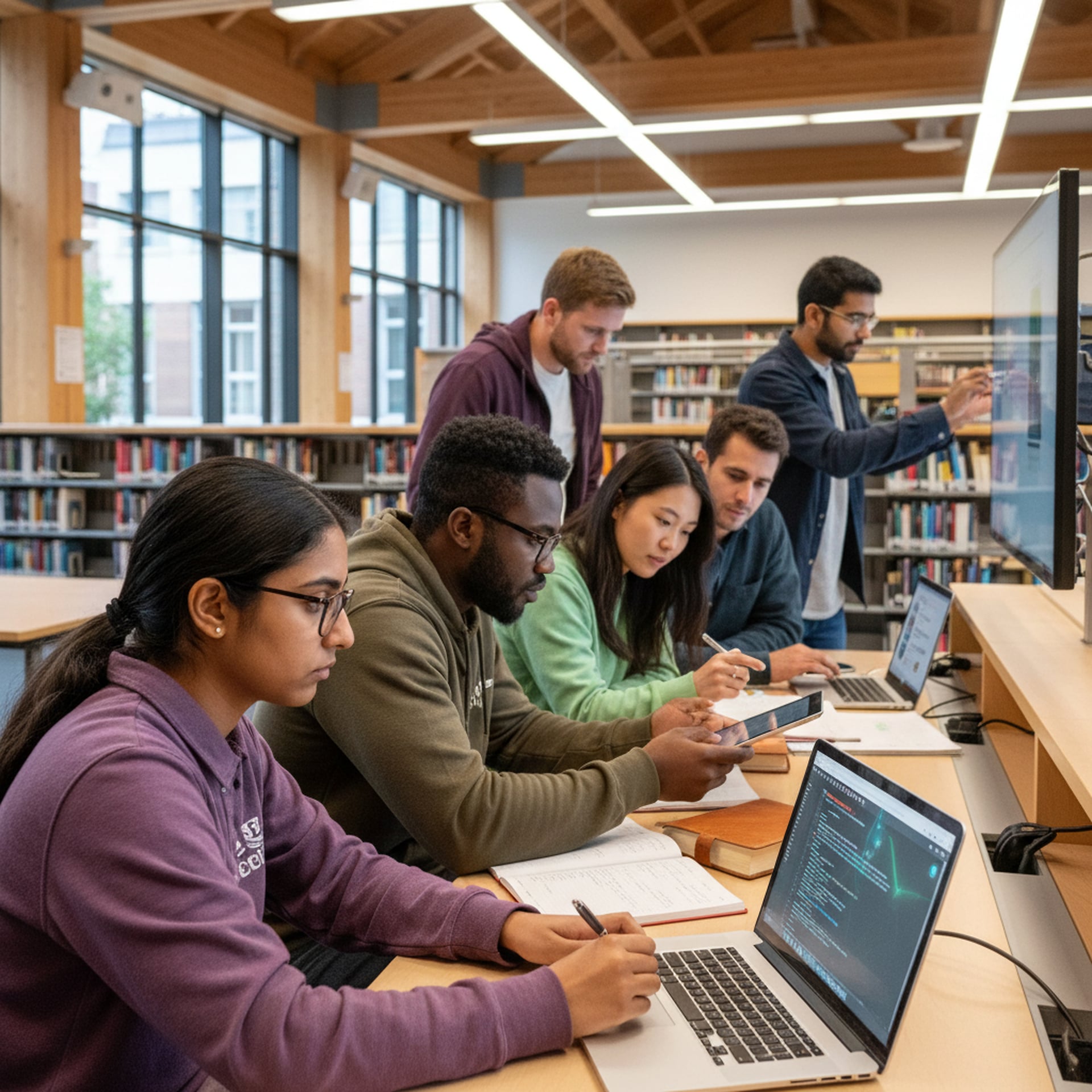
The initial panic surrounding generative artificial intelligence's sudden entry into educational institutions has begun to subside, giving way to a more pragmatic and critical examination of its role in shaping future learning. What started as a knee-jerk reaction of bans and restrictions is evolving into a global conversation centered not on whether students will use AI, but rather how they will interact with it. This fundamental shift in perspective is redefining pedagogical approaches, curriculum development, and the very essence of academic integrity across continents.
The advent of sophisticated AI tools capable of generating text, code, and even creative content has presented an unprecedented challenge to traditional teaching methodologies. Initially, many educators and institutions feared that these technologies would undermine the development of essential skills like critical thinking, original writing, and problem-solving. Concerns were rampant about students relying on AI to complete assignments, thereby circumventing the learning process entirely. This apprehension led to a wave of policies aimed at prohibiting AI use, often accompanied by the development of detection software. However, the pervasive nature of AI, its accessibility, and its rapid integration into various professional sectors quickly made it clear that outright prohibition was neither sustainable nor ultimately beneficial for preparing students for the world they would inherit.
A growing consensus among educational leaders and policymakers worldwide suggests that the focus must pivot from policing AI use to educating students on its responsible, ethical, and effective application. This involves fostering a deep understanding of AI's capabilities and limitations, encouraging its use as a tool for augmentation rather than replacement, and cultivating the discernment necessary to critically evaluate AI-generated outputs. The goal is no longer to prevent students from interacting with AI, but to guide them in becoming proficient and thoughtful users who can leverage these powerful tools to enhance their learning and productivity.
One significant opportunity presented by AI in education is its potential to personalize learning experiences. Adaptive AI systems can tailor content, pace, and feedback to individual student needs, addressing diverse learning styles and academic levels. This could be particularly transformative in large classrooms or in regions with limited educational resources, allowing for a more customized approach that was once the exclusive domain of one-on-one tutoring. AI can also serve as a powerful research assistant, helping students sift through vast amounts of information, summarize complex texts, and even generate initial drafts or outlines, thereby freeing up cognitive load for higher-order thinking, analysis, and synthesis. Furthermore, AI tools can stimulate creativity, offering new avenues for exploration in art, music, and writing, pushing the boundaries of what students can create and imagine.
However, these opportunities are accompanied by significant challenges that demand careful consideration. The most prominent concern remains the potential erosion of critical thinking and original thought. If students become overly reliant on AI to generate ideas or complete tasks, there is a risk that they may not develop the foundational skills necessary for independent intellectual inquiry. Educators are grappling with how to design assignments that encourage AI use as a springboard for deeper engagement, rather than a substitute for it. This requires a re-evaluation of assessment methods, moving towards tasks that emphasize human judgment, ethical reasoning, and the ability to refine and critique AI outputs.
Another critical challenge is ensuring equitable access to these technologies. The digital divide, already a significant barrier to educational equity, could be exacerbated by the uneven distribution of advanced AI tools and the necessary digital literacy skills to utilize them effectively. Institutions in resource-rich environments might integrate AI seamlessly, while those in underserved regions could fall further behind, widening the gap in educational opportunities and outcomes. Addressing this requires concerted efforts to provide infrastructure, devices, and training to all students, irrespective of their socioeconomic background or geographic location.
Moreover, ethical considerations surrounding data privacy, algorithmic bias, and intellectual property are paramount. AI systems are trained on vast datasets, which can sometimes reflect and perpetuate societal biases, leading to skewed or unfair outcomes. Students need to understand these inherent biases and learn to question the information presented by AI. The issue of intellectual property also arises when AI generates content – who owns the output? What constitutes plagiarism when AI is involved? These are complex questions that require ongoing dialogue and the development of clear guidelines within academic institutions globally.
In response to these evolving dynamics, educators are pioneering innovative pedagogical strategies. Many are now explicitly teaching students how to use AI tools, including prompt engineering – the art of crafting effective queries to elicit desired AI responses. This involves instructing students on how to critically evaluate AI-generated content for accuracy, bias, and relevance, emphasizing the human role in fact-checking and refining. Some assignments now require students to disclose their use of AI, providing a transparent framework for its integration. Others are designing tasks that are inherently AI-resistant, focusing on real-world problem-solving, collaborative projects, presentations, or experiential learning that demand human interaction and unique insights. The emphasis is shifting towards process over product, valuing the student's journey of inquiry and critical engagement rather than merely the final output.
Across the global academic community, there is a growing recognition that preparing students for an AI-driven future means equipping them not just with technical skills, but with a robust set of human capabilities. Creativity, empathy, ethical reasoning, adaptability, and complex problem-solving are becoming even more crucial in a world where routine tasks can be automated. Education systems are being urged to foster these uniquely human attributes, ensuring that AI serves as an enhancer of human potential rather than a diminisher.
The conversation surrounding artificial intelligence in education is far from settled, but its direction is becoming clearer. The initial fear-driven responses are giving way to a more thoughtful, proactive approach that acknowledges AI's inevitability and potential. The critical determinant of AI's impact on global education will ultimately be the quality and intentionality of student interaction with these tools. By embracing AI as a powerful, albeit complex, instrument and by teaching students to wield it wisely, ethically, and critically, educational institutions worldwide can navigate this transformative era, preparing a generation that is not only technologically adept but also deeply thoughtful and capable of shaping a better future.
Support Nivaran Foundation's mission to advance global education and health initiatives by contributing to our impactful journalism.
Talk to Nivaran Global