
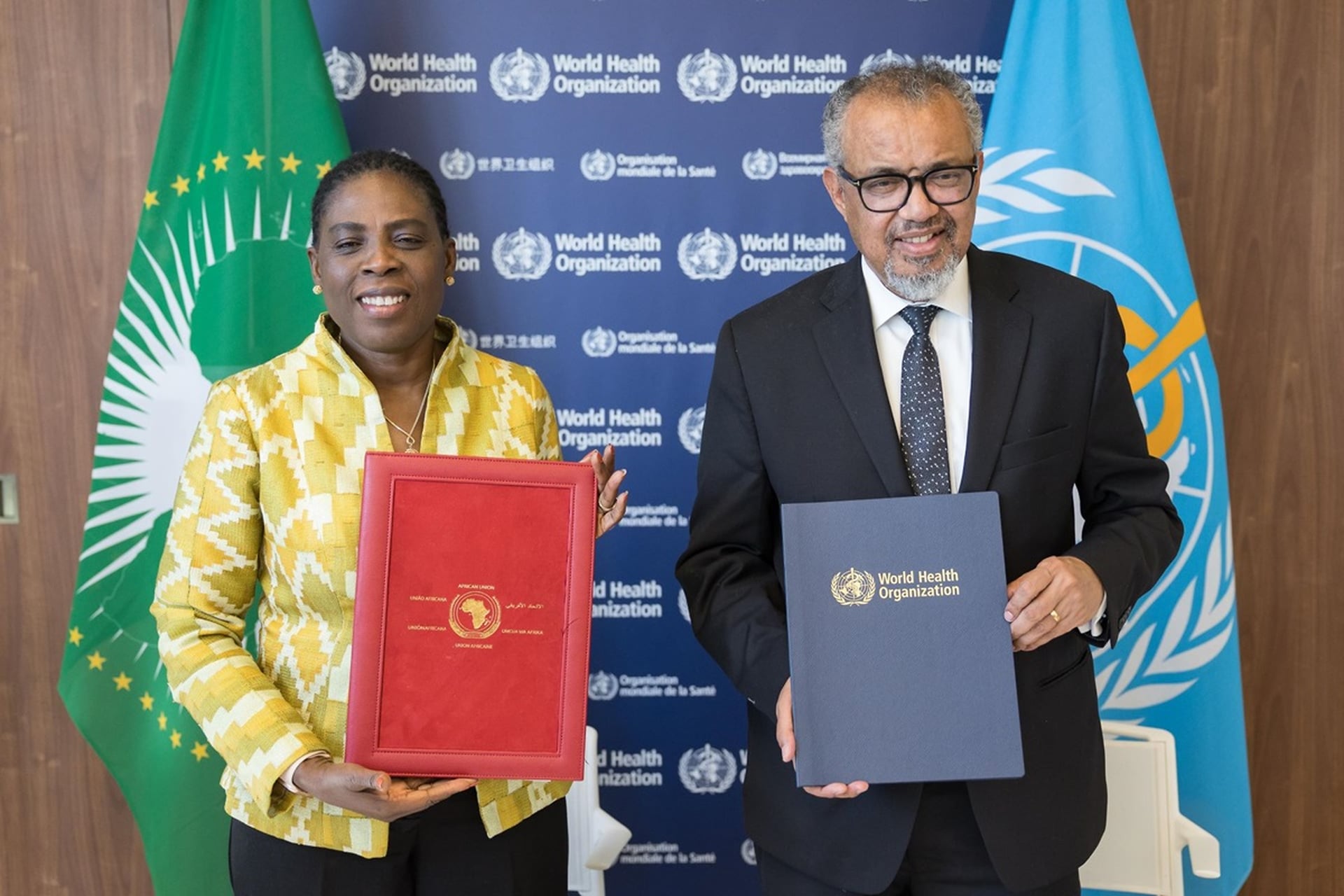
On August 01, 2026, one of the clearest global signals came through WHO.INT: African Union and World Health Organization renew strategic partnership to drive impact and strengthen health systems in Africa. The line may read like a headline, but the implications are operational. The World Health Organization (WHO) and the African Union (AU) Commission renewed their longstanding strategic partnership today with the signing of an updated Memorandum of Understanding (MoU) on the sidelines of the 78th World Health Assembly in Geneva. This renewed agreement reaffirms the joint commitment to advancing health security, universal health coverage, and sustainable development across the African continent at a time of unprecedented financial challenges in the global health landscape. It further underscores the African Union’s leadership in fostering collective action, inclusive partnerships, and regional resilience, and positions the Department of Health, Humanitarian Affairs, and Social Development of the AU Commission at the heart of the continent’s health policy implementation efforts. The agreement was signed by Her Excellency Ambassador Amma Adomaa Twum-Amoah, Commissioner for Health, Humanitarian Affairs and Social Development, on behalf of His Excellency Mahmoud Ali Youssouf, Chairperson of the African Union Commission, and Dr Tedros Adhanom Ghebreyesus, WHO Director-General. It marks a defining moment for primary health care and universal health coverage. Commissioner Twum-Amoah emphasized the strategic importance of the agreement and the AU’s leadership in shaping Africa’s health landscape: “This Agreement marks a new chapter in AU–WHO cooperation. By working together more closely, we can better respond to the health needs of our populations and ensure that no one is left behind. The African Union values WHO’s central and leading role in global health and looks forward to deepening this strategic partnership in support of our shared goals. We need to move from budgeting for survival to planning for health sovereignty,” she added. Building on the foundation of the 2019 MoU, the renewed agreement streamlines and strengthens collaboration across all AU entities. It aligns efforts in support of Africa’s health priorities and sets the stage for enhanced cooperation between WHO and the AU. It also reaffirms WHO’s central technical and normative leadership role in global and regional health, and its commitment to supporting the AU and its institutions in achieving health-related Sustainable Development Goals. “This renewed agreement comes at a critical time, as cuts to bilateral aid imperil the health of millions in Africa,” said Dr Tedros. “It reflects our determination to translate our partnership into tangible results for the people of Africa, and support countries to leave behind the era of aid dependency and transition to sustainable self-reliance. We are proud to stand with the African Union in driving forward the health priorities of the continent.” The Memorandum outlines five key areas of collaboration: health systems strengthening : including regulatory harmonization, support for local pharmaceutical manufacturing, traditional medicine, domestic health financing, workforce development, and digital health innovation; reproductive, maternal, neonatal, child, and adolescent health (RMNCAH) : with continued support for the Campaign on Accelerated Reduction of Maternal Mortality in Africa (CARMMA Plus 2021–2030) and advancement of the reviewed Addis Ababa Declaration on Immunization (ADi); disease prevention and control : supporting the implementation of AU frameworks on communicable and noncommunicable diseases, including efforts to end AIDS, tuberculosis, and malaria; eliminate neglected tropical diseases (NTDs); and address the burden of viral hepatitis in line with WHO strategies; nutrition and food security : strengthening the nutrition agenda through implementation of the Africa Nutrition Strategy 2015–2025 and related WHO strategies; and health in emergency settings : by strengthening joint responses to humanitarian crises, conflicts, and climate-related emergencies. The timing of the renewed agreement is significant. It reflects the African Union’s elevated voice in global health governance – bolstered by its G20 membership – and highlights WHO’s ongoing key role as a trusted technical and operational partner. The renewed MoU marks new momentum for regional and multilateral cooperation to address Africa’s most pressing health challenges and deliver meaningful, lasting results on the continent. For further information: Professor Julio Rakotonirina | Director | Department of Health, Humanitarian Affairs and Social Development | African Union Commission | E-mail JulioR@africa-union.org Ms Stéphanie Seydoux | Director | DG Envoy for Multilateral Affairs| World Health Organization| E-mail seydouxs@who.int In moments like this, the real question is not only what happened, but what gets delayed next: a vaccination schedule, a school meal chain, a maternal referral, or a teacher posting in a district where one interruption can close an entire service corridor.
Health and education are often discussed in separate policy rooms, yet in real communities they are a single daily system. When healthcare access weakens, school attendance drops because children are sick, caregivers are absent, and household budgets are redirected to emergency treatment. When education continuity weakens, health outcomes decline because prevention messages, early warning communication, and basic protective behaviors lose reach. A global development therefore has local consequences long before ministries issue formal guidance.
This is why credibility of source matters as much as speed. Information that is merely loud can push organizations toward reaction theater, while verified reporting supports disciplined action. For frontline teams, discipline means triaging what to monitor first, what to communicate publicly, and which operating assumptions must change before the next shift. The value of a strong signal is not drama. The value is lead time. Lead time is what converts uncertainty into preparedness.
The current signal from WHO.INT sits at the intersection of financing pressure, workforce strain, and uneven access. In many countries, the same local institutions are expected to expand services while absorbing budget volatility, higher caseload complexity, and growing public expectations. That mismatch does not fail all at once. It fails in sequence: first wait times, then coverage reliability, then trust. Once trust breaks, both clinical care and learning continuity become harder to stabilize.
A major blind spot in global commentary is the assumption that policy announcements automatically become implementation reality. Field operations show the opposite. Every policy has a translation gap between central intent and frontline execution. In health, that gap appears as stockouts, referral friction, and uneven triage quality. In education, it appears as absenteeism, content discontinuity, and widening attainment differences. Reporting that ignores this translation gap misses where people actually experience risk.
Another overlooked layer is time. Communities do not experience policy on quarterly timelines. They experience it in daily routines: whether a clinic opens on schedule, whether medicines are available, whether children can safely stay in class, and whether transport remains affordable. A global update matters when it changes those routines, even subtly. Repeated small disruptions accumulate into long-term harm, especially for households already operating with narrow margins.
From a preparedness perspective, the correct response is not panic publishing. It is structured scenario work. If the signal intensifies, what fails first? If it stabilizes, what recovery actions can reduce future fragility? If it reverses, what should remain because it improved resilience anyway? Organizations that pre-define these branches make better decisions under pressure because they are not starting from zero each time a new headline appears.
The public conversation also needs a sharper equity lens. The same global trend can produce very different outcomes depending on geography, income, disability status, migration status, and gender. In better-connected regions, shocks are absorbed by redundancy. In underserved regions, shocks are absorbed by people. Families pay with time, missed wages, deferred treatment, and interrupted learning. That transfer of burden from systems to households is where policy failure becomes social injustice.
For health systems, practical safeguards include tighter early-warning loops, transparent stock monitoring, and referral pathways that remain usable during stress. For education systems, safeguards include continuity plans that protect attendance, reduce dropout risk, and preserve teacher support. Neither set of safeguards is expensive compared with the long-run cost of unmanaged disruption. What is expensive is waiting until service collapse becomes visible in national indicators.
For institutions communicating with the public, clarity is a core intervention. Communities can absorb bad news when information is precise, honest, and actionable. They struggle when messaging alternates between reassurance and alarm with no operational detail. Good communication states what changed, what has not changed, who is affected first, and what concrete steps are available now. That structure reduces fear and improves compliance without sacrificing truth.
For Nivaran's global desk, the standard is simple: follow credible sources, translate implications into human outcomes, and keep the analysis grounded in service continuity. We do not treat health and education as abstract sectors. We treat them as the core infrastructure of dignity. When global signals indicate stress, our responsibility is to map consequence early and publish with enough depth that teams, partners, and readers can act intelligently.
The strongest reporting is not the loudest reporting. It is the reporting that helps decision-makers protect people before systems drift into preventable failure. This update should be read in that spirit: as an early operational map, not a passing headline. If the world is entering a more volatile cycle for public services, then speed must be paired with rigor, and urgency must be paired with accountability. That is how public trust is earned and how outcomes are defended.
There is also a governance lesson here. Governments and institutions that publish assumptions, thresholds, and contingency plans before disruption tend to recover faster than those that communicate only after failure becomes visible. Transparency is not a communications style; it is an operating model. It gives clinicians, school leaders, and local administrators the confidence to escalate early, share constraints, and coordinate across sectors without waiting for perfect certainty. In complex systems, delayed candor is often more damaging than early caution.
The financing side deserves equal attention. A short-term fiscal squeeze can trigger long-term losses when prevention programs are paused, school support services are narrowed, or frontline staffing is treated as variable cost instead of core capacity. The savings appear immediate, but the liabilities arrive later as higher disease burden, lower learning outcomes, and deeper inequality. A resilient approach protects the lowest-cost, highest-impact interventions first, then rebuilds around continuity rather than visible optics.
Digital infrastructure is frequently presented as a silver bullet, but it only helps when paired with human systems that can absorb and act on information. Dashboards do not treat patients. Platforms do not teach children by themselves. Technology is an amplifier: it can strengthen good coordination, or it can scale confusion when governance is weak. The practical test is simple: does new data trigger faster, better decisions at facility and school level, or does it remain trapped in reporting loops disconnected from service?
For readers tracking global developments, the priority is to watch for convergence. When multiple trusted signals point in the same direction, the risk is no longer theoretical. Convergence is the moment to act: tighten continuity plans, protect essential services, strengthen local communication, and measure whether the most vulnerable groups are seeing better outcomes or deeper exclusion. This is where careful reporting becomes practical protection. The objective is not to predict every shock. The objective is to reduce avoidable harm.
Sustained field reporting and accountable publishing are what keep critical global signals visible before they become humanitarian emergencies.
Talk to Nivaran Global