
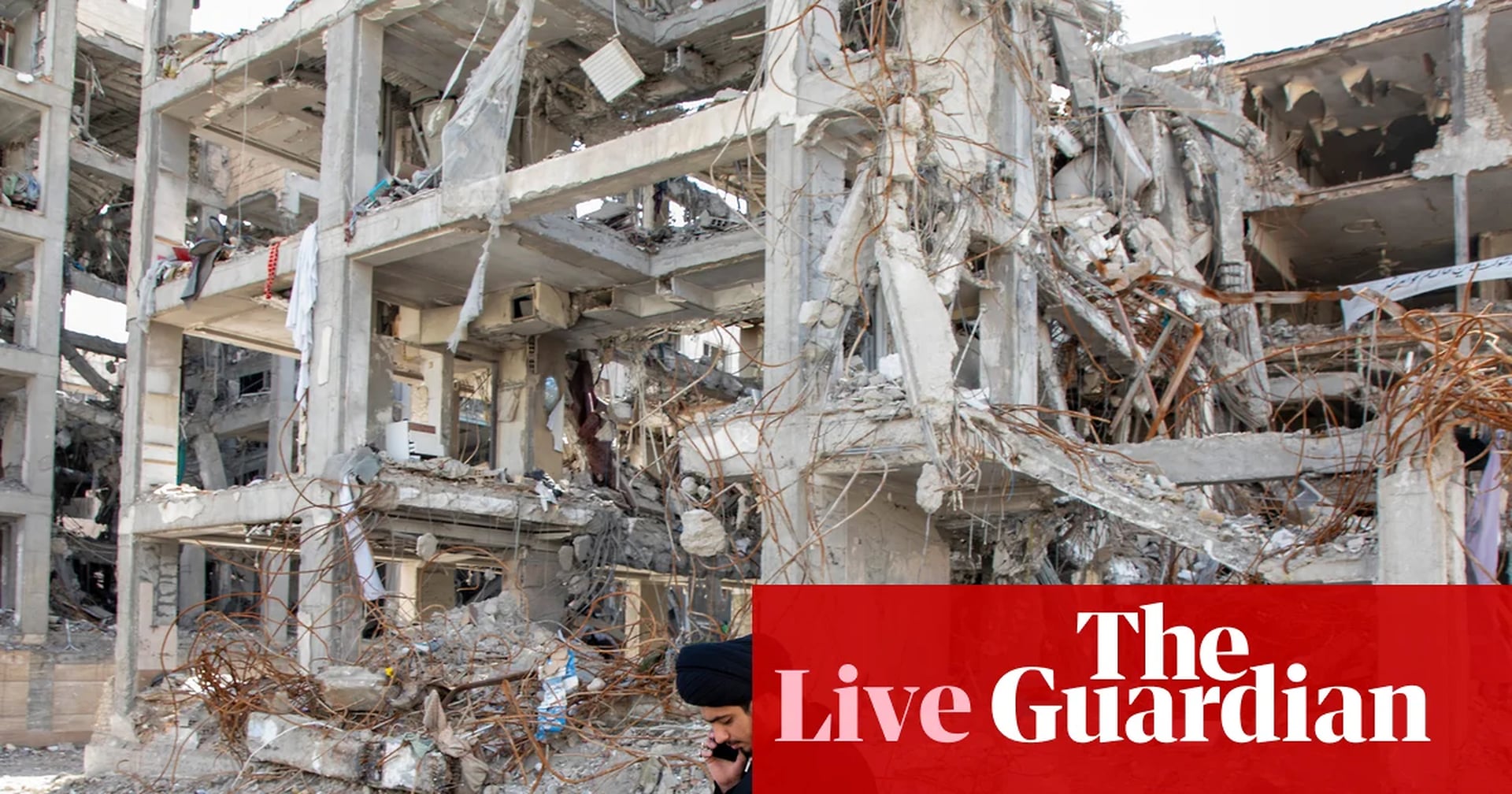
On April 07, 2026, one of the clearest global signals came through THEGUARDIAN.COM: Middle East crisis live: Trump says he is ‘not at all’ worried about possible war crimes as his deadline nears. The line may read like a headline, but the implications are operational. US demands Iran reopen the strait of Hormuz while Tehran rejects 45-day ceasefire proposal and insists it wants permanent end to conflict Talks to end Iran war appear to falter a day before Trump deadline Hello and welcome to our continuing live coverage of the US-Israel war on Iran and its consequences for the region, the world and the global economy. Donald Trump said he was “not at all” concerned about committing possible war crimes as he again threatened to destroy Iran’s bridges and power plants if Tehran does not meet his Tuesday 8pm ET deadline to reopen the strait of Hormuz . The UN security council is expected to vote on Tuesday on a resolution to protect commercial shipping in the strait of Hormuz but in significantly watered-down form after veto-wielding China opposed authorising force, Reuters is reporting, citing diplomats. The Israeli military said early on Tuesday it had completed an “air strike wave” aimed at damaging Iranian regime infrastructure in Tehran and additional areas across Iran. It said soon after that missiles were launched at Israel from Iran and defensive systems were operating to incept them. Israel’s military also said it carried out strikes on three airports in Tehran, targeting several Iranian planes and helicopters. The World Health Organisation suspended medical evacuations from Gaza to Egypt via the Rafah crossing after a contract worker for WHO was killed in Gaza on Monday. Separately, an Israeli airstrike killed at least 10 people outside a school housing displaced Palestinians in central Gaza, health officials said. Before the strikes some Palestinians had clashed with members of an Israeli-backed militia who they said attacked the school, Reuters cited medics and residents as saying. Oil prices extended their rises on Tuesday amid Trump’s heightened rhetoric against Iran. The head of the IMF, meanwhile, said the war would lead to “higher inflation and slower global growth”. The head of International Committee of the Red Cross said that “deliberate threats ... against essential civilian infrastructure and nuclear facilities must not become the new norm in warfare”. Mirjana Spoljaric said, without singling out any country or leader: “Any war fought without limits is incompatible with the law.” Israel said it struck Iran’s largest petrochemical complex on Monday. Israeli prime minister Benjamin Netanyahu said the facility had been “destroyed” and his country was “systematically eliminating the Revolutionary Guards’ money machine”. The intelligence chief of Iran’s Revolutionary Guards, Maj Gen Majid Khademi, was killed in US-Israeli strikes at dawn on Monday, the Guards said. Saudi Arabia intercepted seven ballistic missiles launched towards its eastern region and debris fell in the vicinity of energy facilities , the defence ministry of said on Tuesday. Two blasts were reportedly heard near the Erbil airport – which hosts advisers from the US-led anti-jihadist coalition – in Iraq’s northern Kurdistan region, an Agence France-Presse journalist said. Continue reading... In moments like this, the real question is not only what happened, but what gets delayed next: a vaccination schedule, a school meal chain, a maternal referral, or a teacher posting in a district where one interruption can close an entire service corridor.
Health and education are often discussed in separate policy rooms, yet in real communities they are a single daily system. When healthcare access weakens, school attendance drops because children are sick, caregivers are absent, and household budgets are redirected to emergency treatment. When education continuity weakens, health outcomes decline because prevention messages, early warning communication, and basic protective behaviors lose reach. A global development therefore has local consequences long before ministries issue formal guidance.
This is why credibility of source matters as much as speed. Information that is merely loud can push organizations toward reaction theater, while verified reporting supports disciplined action. For frontline teams, discipline means triaging what to monitor first, what to communicate publicly, and which operating assumptions must change before the next shift. The value of a strong signal is not drama. The value is lead time. Lead time is what converts uncertainty into preparedness.
The current signal from THEGUARDIAN.COM sits at the intersection of financing pressure, workforce strain, and uneven access. In many countries, the same local institutions are expected to expand services while absorbing budget volatility, higher caseload complexity, and growing public expectations. That mismatch does not fail all at once. It fails in sequence: first wait times, then coverage reliability, then trust. Once trust breaks, both clinical care and learning continuity become harder to stabilize.
A major blind spot in global commentary is the assumption that policy announcements automatically become implementation reality. Field operations show the opposite. Every policy has a translation gap between central intent and frontline execution. In health, that gap appears as stockouts, referral friction, and uneven triage quality. In education, it appears as absenteeism, content discontinuity, and widening attainment differences. Reporting that ignores this translation gap misses where people actually experience risk.
Another overlooked layer is time. Communities do not experience policy on quarterly timelines. They experience it in daily routines: whether a clinic opens on schedule, whether medicines are available, whether children can safely stay in class, and whether transport remains affordable. A global update matters when it changes those routines, even subtly. Repeated small disruptions accumulate into long-term harm, especially for households already operating with narrow margins.
From a preparedness perspective, the correct response is not panic publishing. It is structured scenario work. If the signal intensifies, what fails first? If it stabilizes, what recovery actions can reduce future fragility? If it reverses, what should remain because it improved resilience anyway? Organizations that pre-define these branches make better decisions under pressure because they are not starting from zero each time a new headline appears.
The public conversation also needs a sharper equity lens. The same global trend can produce very different outcomes depending on geography, income, disability status, migration status, and gender. In better-connected regions, shocks are absorbed by redundancy. In underserved regions, shocks are absorbed by people. Families pay with time, missed wages, deferred treatment, and interrupted learning. That transfer of burden from systems to households is where policy failure becomes social injustice.
For health systems, practical safeguards include tighter early-warning loops, transparent stock monitoring, and referral pathways that remain usable during stress. For education systems, safeguards include continuity plans that protect attendance, reduce dropout risk, and preserve teacher support. Neither set of safeguards is expensive compared with the long-run cost of unmanaged disruption. What is expensive is waiting until service collapse becomes visible in national indicators.
For institutions communicating with the public, clarity is a core intervention. Communities can absorb bad news when information is precise, honest, and actionable. They struggle when messaging alternates between reassurance and alarm with no operational detail. Good communication states what changed, what has not changed, who is affected first, and what concrete steps are available now. That structure reduces fear and improves compliance without sacrificing truth.
For Nivaran's global desk, the standard is simple: follow credible sources, translate implications into human outcomes, and keep the analysis grounded in service continuity. We do not treat health and education as abstract sectors. We treat them as the core infrastructure of dignity. When global signals indicate stress, our responsibility is to map consequence early and publish with enough depth that teams, partners, and readers can act intelligently.
The strongest reporting is not the loudest reporting. It is the reporting that helps decision-makers protect people before systems drift into preventable failure. This update should be read in that spirit: as an early operational map, not a passing headline. If the world is entering a more volatile cycle for public services, then speed must be paired with rigor, and urgency must be paired with accountability. That is how public trust is earned and how outcomes are defended.
There is also a governance lesson here. Governments and institutions that publish assumptions, thresholds, and contingency plans before disruption tend to recover faster than those that communicate only after failure becomes visible. Transparency is not a communications style; it is an operating model. It gives clinicians, school leaders, and local administrators the confidence to escalate early, share constraints, and coordinate across sectors without waiting for perfect certainty. In complex systems, delayed candor is often more damaging than early caution.
The financing side deserves equal attention. A short-term fiscal squeeze can trigger long-term losses when prevention programs are paused, school support services are narrowed, or frontline staffing is treated as variable cost instead of core capacity. The savings appear immediate, but the liabilities arrive later as higher disease burden, lower learning outcomes, and deeper inequality. A resilient approach protects the lowest-cost, highest-impact interventions first, then rebuilds around continuity rather than visible optics.
Digital infrastructure is frequently presented as a silver bullet, but it only helps when paired with human systems that can absorb and act on information. Dashboards do not treat patients. Platforms do not teach children by themselves. Technology is an amplifier: it can strengthen good coordination, or it can scale confusion when governance is weak. The practical test is simple: does new data trigger faster, better decisions at facility and school level, or does it remain trapped in reporting loops disconnected from service?
For readers tracking global developments, the priority is to watch for convergence. When multiple trusted signals point in the same direction, the risk is no longer theoretical. Convergence is the moment to act: tighten continuity plans, protect essential services, strengthen local communication, and measure whether the most vulnerable groups are seeing better outcomes or deeper exclusion. This is where careful reporting becomes practical protection. The objective is not to predict every shock. The objective is to reduce avoidable harm.
Sustained field reporting and accountable publishing are what keep critical global signals visible before they become humanitarian emergencies.
Talk to Nivaran Global