
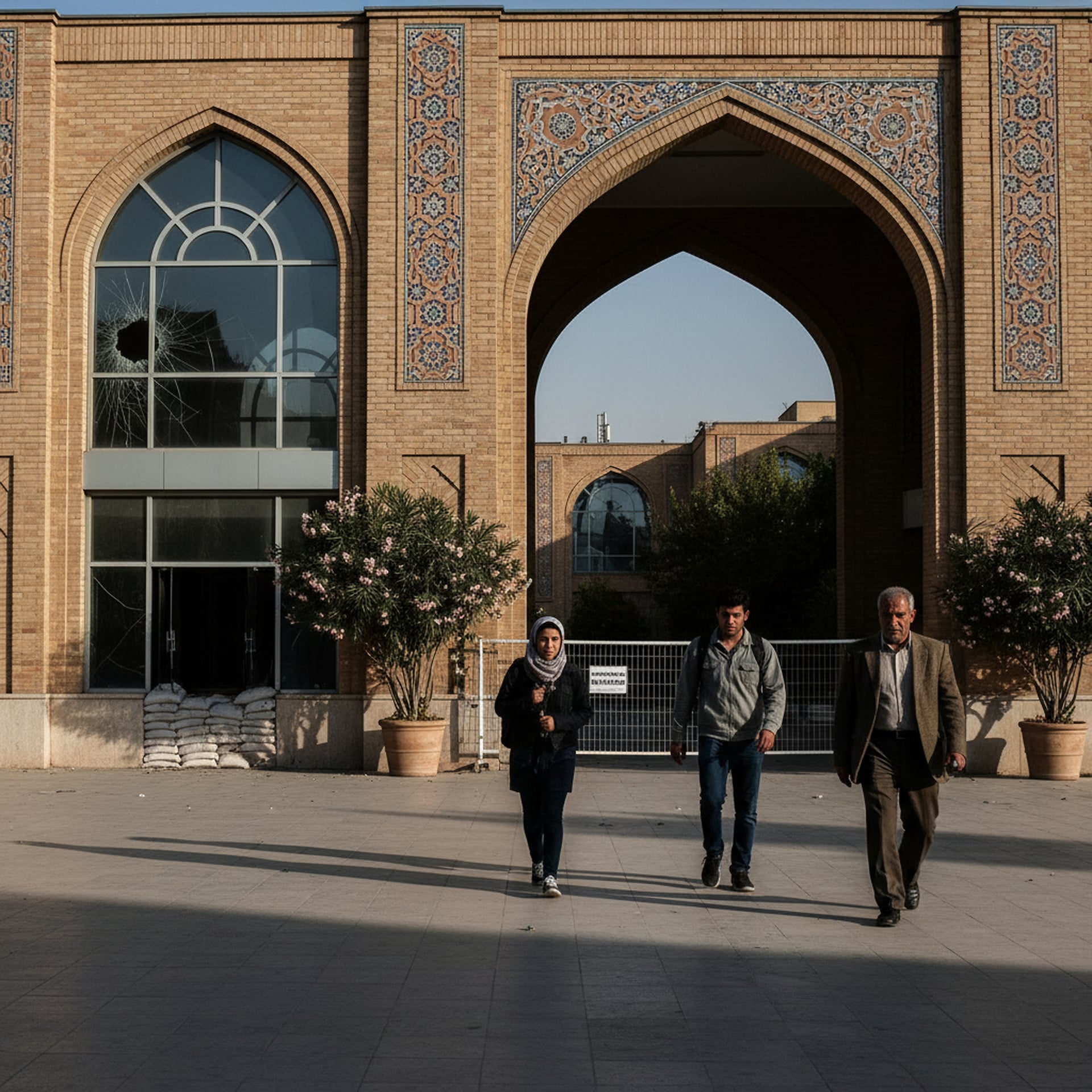
The recent strike on Tehran's esteemed Sharif University of Technology has ignited a firestorm of condemnation across Iran, uniting an otherwise deeply divided populace in a rare display of shared outrage. Both government officials and prominent anti-government activists have vociferously denounced the assault on what is widely considered a cornerstone of Iranian intellectual life, marking a significant moment in the ongoing challenges faced by the nation's higher education sector. This incident is not isolated, following a pattern of attacks on Iranian centers for learning, raising profound concerns about the sanctity of academic institutions in times of geopolitical tension.
Sharif University of Technology stands as a beacon of academic excellence, not just within Iran but across the broader Middle East. Renowned for its rigorous programs in engineering, computer science, and applied sciences, it has consistently produced a disproportionate number of Iran's scientific and technological leaders, innovators, and entrepreneurs. Its alumni frequently contribute to global advancements, underscoring the institution's critical role in national development and international scientific discourse. An attack on such an institution is therefore perceived not merely as an assault on a building, but as a direct strike against the nation's future intellectual capacity and its potential for progress. The university's campus, typically bustling with students engaged in research, lectures, and collaborative projects, represents a vibrant ecosystem dedicated to the pursuit of knowledge and innovation. The disruption caused by such an act extends far beyond physical damage, impacting the morale and academic trajectory of thousands of young minds.
What makes this particular incident especially noteworthy is the breadth of the condemnation it has elicited. In a political landscape often characterized by stark ideological divisions, the unified outcry from both state apparatuses and their most vocal critics highlights a fundamental societal consensus: educational institutions must remain sacrosanct. For government officials, the defense of Sharif University is a matter of national sovereignty and protecting key strategic assets. For anti-government activists, it represents the safeguarding of a space for critical thinking, intellectual freedom, and the future prospects of Iranian youth, irrespective of political affiliation. This rare convergence of opinion underscores the deep cultural value placed on education within Iranian society, transcending political fault lines and reaffirming a collective commitment to academic integrity. The shared indignation reflects a deep-seated belief that universities are neutral grounds, essential for societal advancement and immune from conflict.
The targeting of Sharif University is part of a disturbing trend impacting higher education in various conflict zones globally. When universities become targets, the ripple effects are catastrophic. Students face disrupted studies, faculty members are displaced, research initiatives are halted, and the overall academic environment is destabilized. Such attacks not only inflict immediate physical damage but also sow fear and uncertainty, potentially leading to a "brain drain" as talented individuals seek safer environments to pursue their education and careers. The long-term consequences include a decline in educational standards, a weakening of scientific and technological capabilities, and a profound psychological toll on entire generations. For a nation like Iran, which prides itself on its rich intellectual heritage and significant contributions to science and philosophy, these attacks represent a direct assault on its cultural identity and future aspirations.
International humanitarian law explicitly calls for the protection of civilian infrastructure, including schools and universities, during armed conflicts. These institutions are meant to be safe havens, dedicated to learning and the advancement of human knowledge, even amidst broader hostilities. Attacks on educational facilities violate these fundamental principles, undermining the very fabric of civil society and impeding post-conflict recovery and development. The global community has a vested interest in upholding these norms, as the destruction of educational infrastructure in one region has far-reaching implications for global intellectual exchange and human progress. Organizations dedicated to education and human rights frequently advocate for stronger protections and accountability for those who target academic institutions.
From the perspective of the Nivaran Foundation, which champions global education and health initiatives, the attack on Sharif University serves as a stark reminder of the urgent need to protect educational spaces worldwide. Education is not merely a privilege but a fundamental human right and a critical driver of sustainable development, peace, and social cohesion. When universities are compromised, the ability of societies to innovate, to address complex challenges, and to foster informed citizenship is severely hampered. The Foundation believes that robust international frameworks and collective action are essential to ensure that students and educators can pursue knowledge in safety, free from the threat of violence and disruption. Safeguarding these institutions is an investment in humanity's collective future, ensuring that the next generation has the tools and opportunities to build a more peaceful and prosperous world.
The condemnation from within Iran, uniting disparate political factions, should resonate globally as a powerful testament to the universal value of education. It underscores a shared understanding that the pursuit of knowledge transcends political divides and must be shielded from conflict. The international community, therefore, bears a responsibility to not only condemn such acts but also to actively work towards preventing them. This involves advocating for stronger adherence to international humanitarian law, supporting initiatives that rebuild and protect educational infrastructure in conflict zones, and fostering dialogue that prioritizes academic freedom and the safety of students and faculty. The future of global progress hinges on our collective ability to protect the sanctity of learning environments, allowing them to flourish as centers of innovation, critical thought, and human potential. The incident at Sharif University is a poignant reminder that the battle for education is a battle for the future itself, demanding unwavering vigilance and concerted action from all stakeholders.
The attack on Sharif University of Technology is a grave reminder of the vulnerabilities faced by educational institutions in an increasingly volatile world. The unified condemnation from within Iran highlights a profound societal value placed on learning, a sentiment that should echo across international borders. As the global community grapples with myriad challenges, the imperative to protect and preserve centers of higher education remains paramount. These institutions are not just buildings; they are crucibles of innovation, bastions of intellectual freedom, and the wellsprings of future leadership. Ensuring their safety and continuity is a collective duty, vital for fostering resilient societies and advancing human progress everywhere.
Support Nivaran Foundation's mission to safeguard education and health initiatives globally, ensuring access to learning even in conflict-affected regions.
Talk to Nivaran Global