
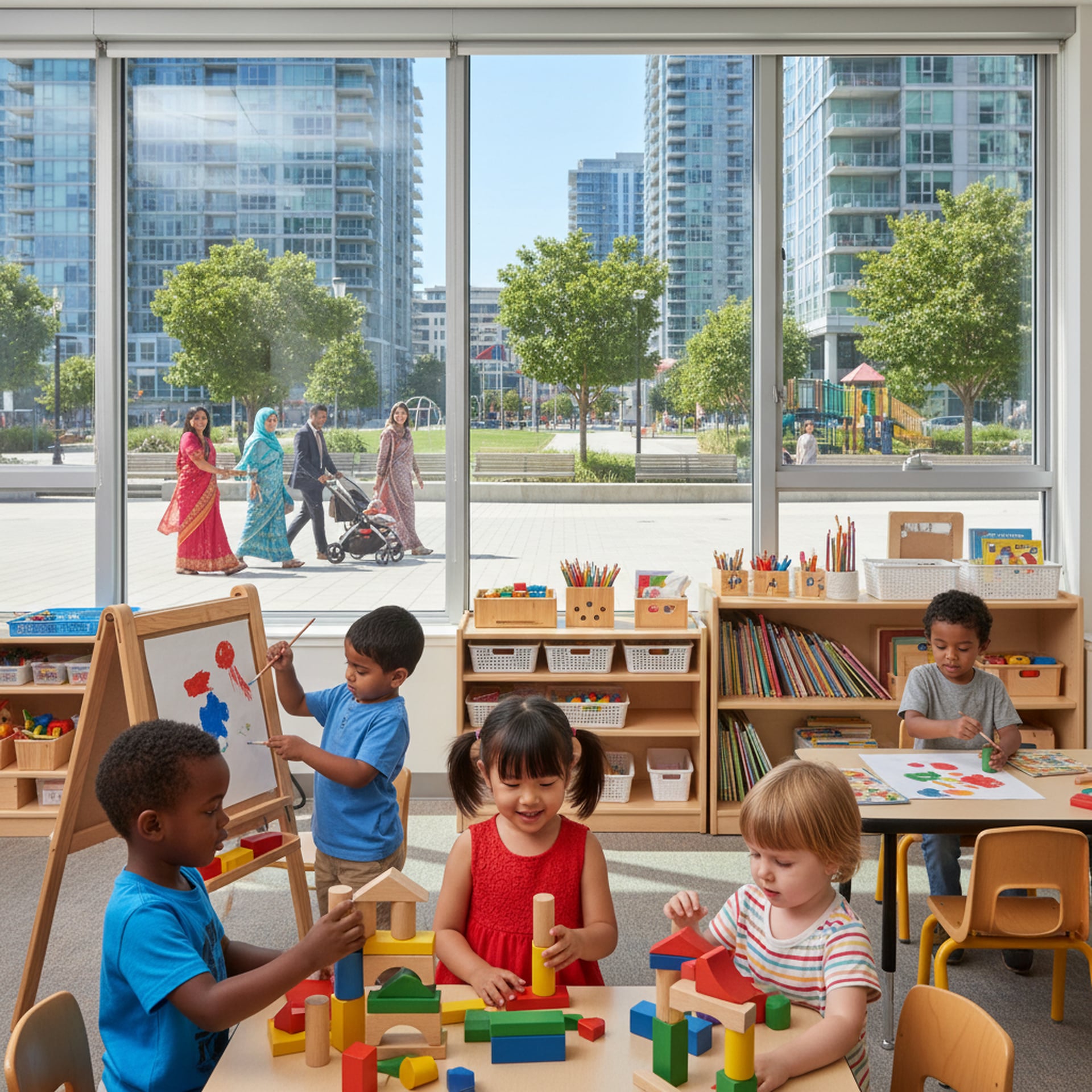
The global push for universal early childhood education and care (ECEC) has gained significant momentum, recognized as a cornerstone for societal development, economic growth, and individual well-being. Across continents, governments and international organizations champion ECEC as a fundamental right, crucial for cognitive and social development in children, fostering gender equality by enabling parental workforce participation, and breaking cycles of poverty. Yet, the path to truly universal and equitable provision is fraught with complex challenges, particularly concerning resource allocation and the inherent paradoxes that arise when implementing such programs in diverse socio-economic landscapes.
A recent development in a prominent global city, where a new, publicly funded preschool center opened its doors in one of the most affluent urban districts, has reignited a critical debate. This initiative, part of a broader commitment to expanding universal child care, prompts a fundamental question: how should public resources be distributed when the goal is universal access? When families in these wealthy enclaves are accustomed to private services, often paying substantial sums for premium amenities and education, the provision of free, high-quality public alternatives raises eyebrows and sparks discussions about fairness, necessity, and the optimal use of taxpayer money. The underlying tension lies in balancing the principle of universality – that all children, regardless of their parents' income or zip code, deserve access to quality early learning – with the practical realities of finite public budgets and the pressing needs of underserved communities.
Proponents of universal ECEC argue that its benefits extend far beyond individual families. Early childhood education is not merely a custodial service; it is a critical investment in human capital. Research consistently demonstrates that high-quality ECEC leads to improved academic outcomes, higher earning potential, better health, and reduced crime rates in adulthood. For parents, particularly mothers, access to affordable and reliable child care is a key enabler for workforce participation, boosting economic productivity and contributing to gender equity. From this perspective, providing universal access, even to the affluent, is seen as a societal good, fostering social cohesion and ensuring that no child is left behind, regardless of their family’s financial standing. The argument posits that a truly universal system avoids the stigma often associated with means-tested programs and simplifies administration, ultimately benefiting everyone.
However, critics and policy analysts often highlight the potential for such universal programs to inadvertently exacerbate existing inequalities if not meticulously designed. When free services are introduced in areas where families already have access to and can afford high-quality private options, the public investment might not yield the same transformative impact as it would in low-income neighborhoods. In affluent areas, families might already be engaging in extensive early learning activities, and the public provision might simply displace private spending rather than create new opportunities. The concern is that scarce public funds, which could be channeled to areas with profound educational and developmental deficits, are instead being used to subsidize families who are perfectly capable of affording child care themselves. This raises questions about distributive justice and whether the "universal" ideal is being applied in a way that truly maximizes social benefit and addresses the most acute needs.
The debate is not unique to any single city or nation; it echoes across the globe as countries grapple with the implementation of comprehensive ECEC policies. In many developing economies, the challenge is often one of basic access and quality, with millions of children lacking any form of structured early learning. Here, the focus is squarely on building foundational infrastructure, training educators, and ensuring minimum standards of health and safety. The idea of extending free services to the wealthiest segments of society, while vast populations struggle with poverty and lack of basic services, can seem incongruous and even morally questionable. Governments in these regions often face immense pressure to prioritize resources for primary healthcare, clean water, and basic education, making the allocation for universal, high-quality ECEC a complex political and economic calculus.
Even in developed nations with robust welfare states, the funding models for ECEC vary widely and are subject to constant re-evaluation. Some countries adopt heavily subsidized models, where parents pay a sliding scale fee based on income, ensuring affordability while still generating some revenue. Others, like the Nordic countries, are closer to a truly universal, largely free model, funded through high taxation. Yet, even in these systems, discussions persist about the quality of care, the remuneration of early childhood educators, and the optimal balance between public and private provision. The cost of providing high-quality ECEC is substantial, encompassing not just facilities but also highly trained staff, curriculum development, and ongoing professional development. These costs escalate significantly when aiming for truly universal access across all socio-economic strata.
The economic implications of different child care policies are profound. When child care is unaffordable or inaccessible, it acts as a significant barrier to employment, particularly for women. This not only impacts individual family incomes but also reduces the overall labor supply and economic output of a nation. Conversely, investing in ECEC can yield significant economic returns through increased tax revenues, reduced welfare dependency, and a more skilled future workforce. However, the challenge lies in how these investments are targeted. If the primary goal is to boost workforce participation and reduce poverty, then directing resources towards low-income families and underserved communities might offer a higher return on investment than a blanket universal approach that includes the affluent.
Furthermore, the quality of early childhood education is paramount. A "free" service that is substandard or overcrowded can do more harm than good, failing to deliver the promised developmental benefits. Ensuring high standards across a universal system requires substantial investment in educator training, competitive salaries to attract and retain talent, and robust regulatory frameworks. This is a significant hurdle for many governments, irrespective of their economic standing. The temptation to cut corners to expand access quickly can compromise quality, undermining the very purpose of universal ECEC.
The global dialogue around universal child care is thus a nuanced one, requiring careful consideration of national contexts, economic realities, and social priorities. While the aspiration for every child to have access to quality early learning is universally shared, the implementation strategies must be adaptable and equitable. Policy makers are continually tasked with striking a delicate balance: upholding the principle of universality while ensuring that public funds are deployed in a manner that addresses the most pressing needs, reduces disparities, and maximizes societal benefit. The debate sparked by a free preschool in an affluent neighborhood is not merely about local politics; it is a microcosm of a much larger, global conversation about how societies prioritize, fund, and deliver on the promise of a brighter future for all children. It underscores the ongoing challenge of translating noble ideals into practical, equitable, and sustainable policies that truly serve the diverse needs of a global population. The path forward demands innovative funding mechanisms, targeted interventions where necessary, and a steadfast commitment to quality, ensuring that universal access genuinely translates into universal opportunity.
Support Nivaran Foundation's efforts to advocate for equitable education and health access for children worldwide.
Talk to Nivaran Global