
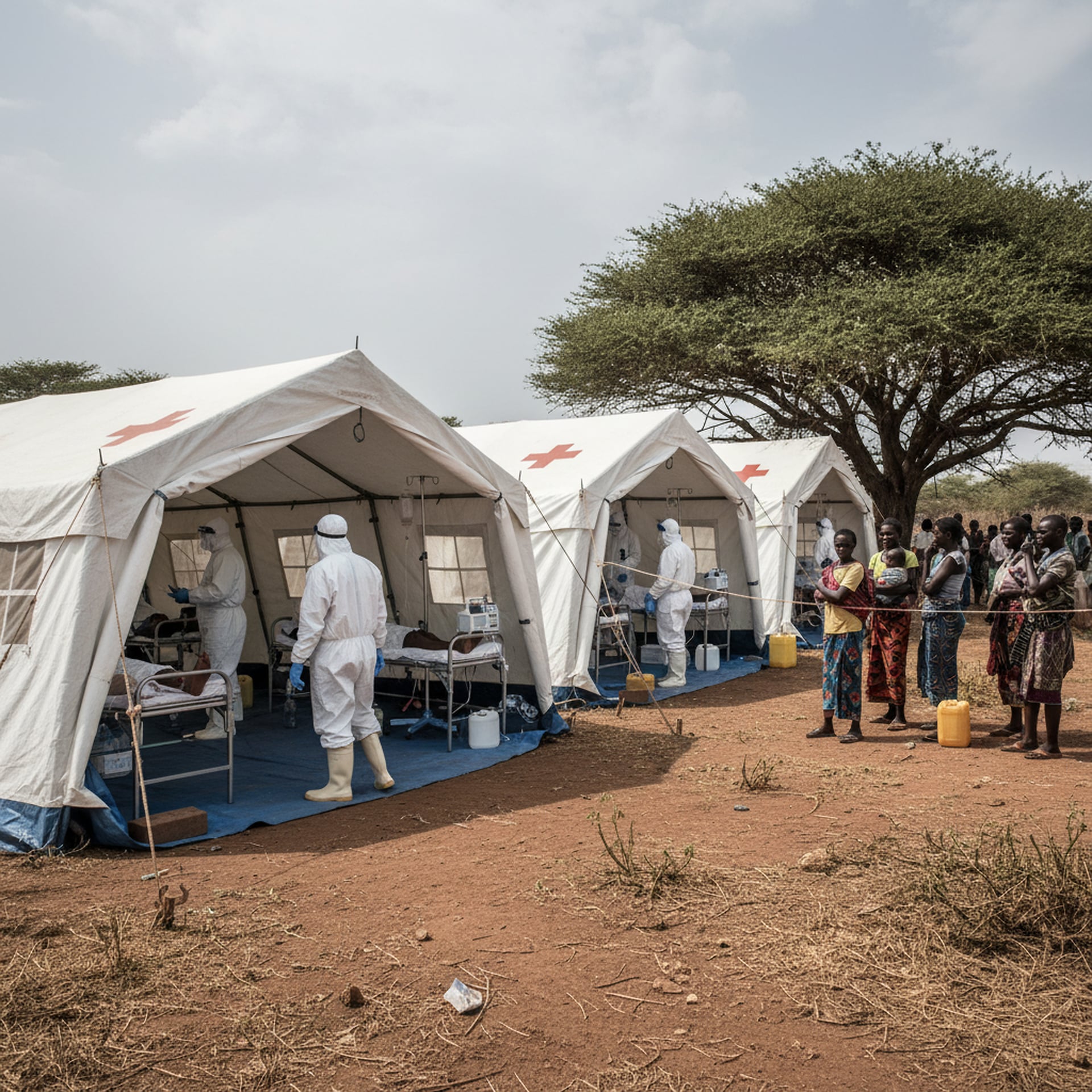
The World Health Organization (WHO) has officially declared the escalating Ebola outbreak in Central Africa a Public Health Emergency of International Concern (P.H.E.I.C.), signaling a critical juncture in the global fight against the deadly virus. This pivotal announcement, made on May 17, 2026, comes just a day after new cases were confirmed across the border in Uganda, alongside the ongoing struggle within the Democratic Republic of Congo (DRC). The declaration underscores the severe risk of international spread and the urgent need for a coordinated, robust global response, particularly alarming given the current absence of an approved vaccine specifically tailored for this virulent species of Ebola.
The current outbreak, primarily centered in the eastern regions of the Democratic Republic of Congo, has presented unprecedented challenges since its inception. The affected areas are often characterized by active conflict zones, significant population displacement, and a deeply entrenched distrust of external health interventions, all of which severely impede containment efforts. Health workers and humanitarian organizations have been operating under immense pressure, navigating not only the immediate medical crisis but also complex security threats and logistical hurdles. The cross-border transmission into Uganda, a nation with its own history of battling infectious diseases, served as a stark reminder of the virus's potential to rapidly transcend national boundaries, necessitating an immediate elevation of the international response.
A P.H.E.I.C. declaration by the WHO is the highest level of alert the organization can issue, reserved for events that pose a significant public health risk to other states through the international spread of disease and potentially require a coordinated international response. This designation mobilizes greater international attention, funding, and resources, enabling a more unified approach to surveillance, contact tracing, isolation, treatment, and community engagement. It also often triggers travel advisories and enhanced screening measures in neighboring countries and beyond, though the WHO typically advises against blanket travel or trade restrictions, emphasizing that such measures can hinder rather than help the response by isolating affected regions. The decision to declare a P.H.E.I.C. is not taken lightly, reflecting a careful assessment of the outbreak's severity, its potential for international spread, and the capacity of affected countries to manage it independently. In this instance, the combination of persistent local transmission, the geographical spread into a neighboring country, and the specific challenge of an un-vaccine-protected strain pushed the situation past the threshold.
The medical challenges posed by this particular Ebola outbreak are formidable. Ebola virus disease (EVD) is a severe, often fatal illness in humans, with an average case fatality rate of around 50%. The virus is transmitted to people from wild animals and spreads in the human population through direct contact with the blood, secretions, organs, or other bodily fluids of infected people, and with surfaces and materials (e.g., bedding, clothing) contaminated with these fluids. Symptoms include fever, fatigue, muscle pain, headache, and sore throat, followed by vomiting, diarrhea, rash, symptoms of impaired kidney and liver function, and in some cases, both internal and external bleeding. The critical issue in this current outbreak is the lack of an approved, specific vaccine for this exact species of Ebola. While experimental vaccines and treatments exist and have shown promise in other outbreaks, their deployment and efficacy against this specific strain are still under evaluation or not yet widely available, leaving frontline responders reliant on rigorous infection control, supportive care, and rapid diagnostics. This gap in specific prophylactic tools significantly complicates the containment strategy, placing an even greater emphasis on public health measures.
Beyond the immediate medical response, logistical and social challenges loom large. Reaching remote communities, often cut off by poor infrastructure or insecurity, is a constant battle. Maintaining the cold chain for temperature-sensitive medical supplies, including potential experimental vaccines or treatments, in tropical climates with unreliable electricity is another significant hurdle. Security concerns for health workers, who have sometimes faced hostility and violence from communities wary of outsiders or misinformed about the disease, further complicate efforts. On the social front, deeply ingrained cultural practices, particularly around burial rituals that involve close contact with the deceased, can inadvertently accelerate transmission. Overcoming these barriers requires intensive community engagement, building trust through transparent communication, and involving local leaders and traditional healers in the response efforts. Misinformation and rumors, often fueled by fear and historical grievances, must be actively countered with accurate, culturally sensitive public health messaging.
The international response, spearheaded by the WHO, involves a multi-pronged approach. This includes deploying epidemiologists, clinicians, logisticians, and public health experts to support national efforts. Non-governmental organizations (NGOs) such as Médecins Sans Frontières (MSF) and the International Federation of Red Cross and Red Crescent Societies (IFRC) are crucial partners, providing direct patient care, setting up treatment centers, and conducting community outreach. The focus is on strengthening surveillance systems to quickly identify new cases, meticulously tracing contacts to break chains of transmission, ensuring safe and dignified burials, and providing comprehensive supportive care to those infected. Furthermore, efforts are underway to accelerate research and development for vaccines and therapeutics specifically targeting this strain, a process that is inherently complex and time-consuming.
The broader economic and social impacts of such an outbreak are profound and far-reaching. Local economies, already fragile, suffer immensely as trade and movement of people are restricted, impacting agriculture, markets, and small businesses. Children's education is often disrupted by school closures or the reallocation of resources, potentially setting back an entire generation. The psychological toll on affected communities, who live under the constant threat of disease, and on the dedicated health workers, who witness immense suffering and face personal risks, cannot be overstated. These secondary impacts underscore the need for a holistic response that extends beyond immediate medical intervention to include social support, economic recovery initiatives, and long-term investment in community resilience.
Preventative measures and global preparedness remain paramount. Rapid diagnostics are essential for early detection, allowing for prompt isolation of cases and initiation of contact tracing. Robust border surveillance and screening measures in neighboring countries are critical to prevent further international spread. However, the most effective long-term strategy involves strengthening the fundamental health systems in vulnerable regions. This means investing in primary healthcare, training local health professionals, improving laboratory capacities, and establishing robust public health infrastructure capable of detecting and responding to outbreaks swiftly. Lessons learned from previous Ebola outbreaks, such as the importance of early intervention, community trust, and flexible response mechanisms, are being continually integrated into current strategies.
Looking ahead, the immediate priorities are clear: intensify surveillance, expand treatment capacity, ensure safe burials, and accelerate community engagement to foster trust and cooperation. In the longer term, there is an urgent need for sustained global investment in research and development to create effective vaccines and treatments for all known Ebola strains, alongside strengthening health systems in high-risk areas to prevent future epidemics. This declaration serves as a stark reminder of our interconnectedness and the imperative for global solidarity in addressing health threats that know no borders. The Nivaran Foundation emphasizes that the fight against Ebola is not just a regional challenge but a collective global responsibility, demanding sustained commitment and resources to protect humanity from future outbreaks.
Your support enables Nivaran Foundation to strengthen health systems and deliver vital aid in regions vulnerable to global health emergencies like Ebola.
Talk to Nivaran Global