
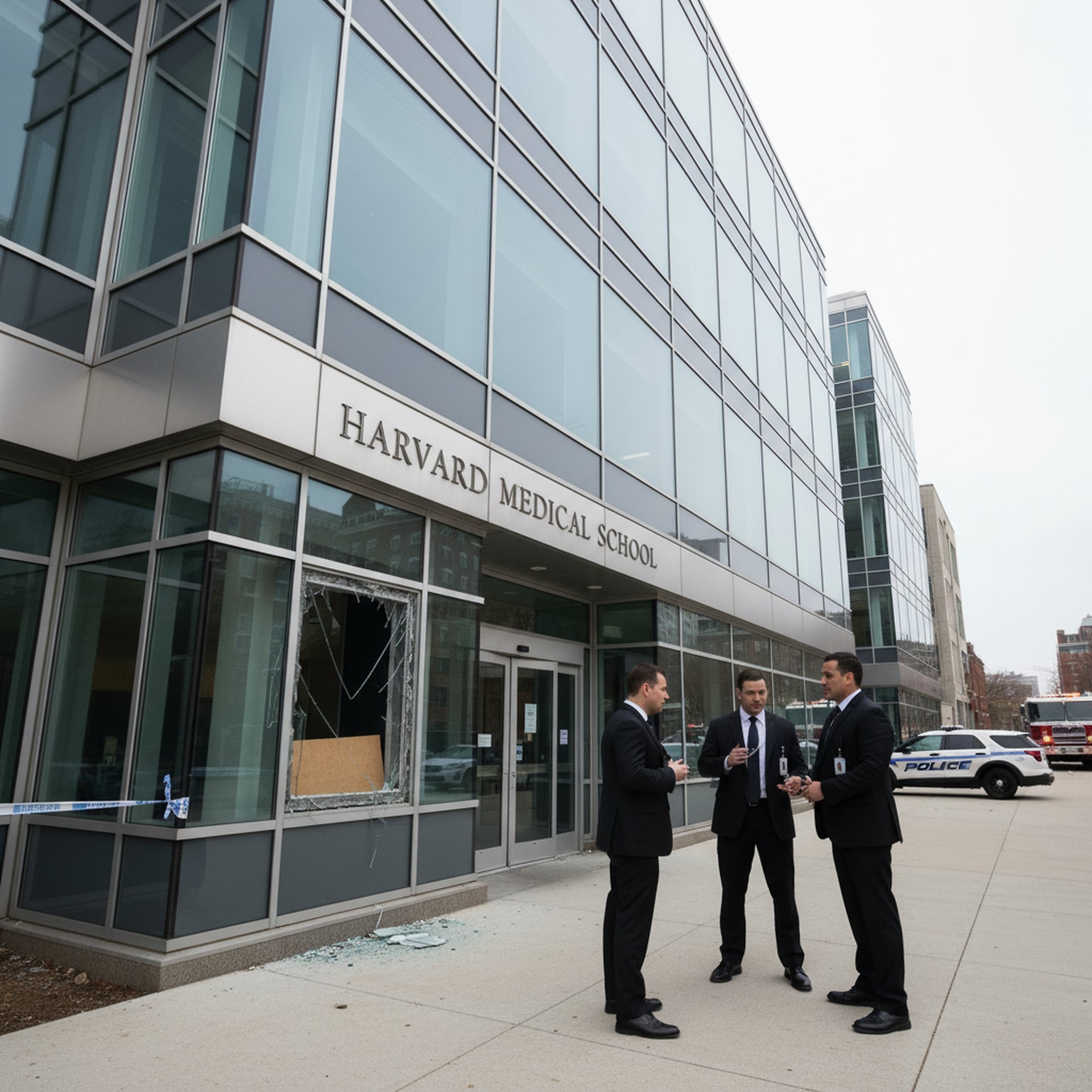
In a development that has resonated across the global academic and scientific community, two individuals, Logan David Patterson, aged 18, and Dominick Frank Cardoza, 21, have formally entered guilty pleas in connection with a significant incident at Harvard Medical School. The charges relate to their involvement in the detonation of a commercial firework within a sensitive research laboratory last November, an act that has prompted widespread discussion regarding the security vulnerabilities of leading educational and scientific institutions worldwide. The incident, while geographically confined to a single campus, carries profound implications for the safeguarding of intellectual capital, critical infrastructure, and the personnel dedicated to advancing global health and knowledge.
The November event unfolded with alarming speed, as a commercial-grade firework was illicitly discharged within the confines of a research facility at one of the world's most prestigious medical schools. While the immediate extent of the damage to the laboratory's delicate equipment and ongoing experiments was not fully detailed in public records, the inherent risks associated with such an act are considerable. Research laboratories, particularly those engaged in medical science, often house highly specialized and irreplaceable instruments, sensitive biological samples, and proprietary data. The potential for fire, chemical contamination, structural compromise, or the destruction of years of meticulous research work represents a severe threat to scientific progress and the substantial investments made in these endeavors. Such an act not only jeopardizes physical assets but also the continuity of vital projects aimed at addressing global health challenges, from disease eradication to the development of new therapies.
The guilty pleas by Patterson and Cardoza mark a critical juncture in the legal proceedings, bringing a degree of closure to the immediate investigation but opening broader questions about accountability and prevention. Given their ages, the legal consequences for both individuals are expected to be substantial, serving as a stark reminder of the serious repercussions for reckless or malicious acts committed within academic settings. The judicial process underscores that such incidents are not merely acts of vandalism but serious offenses with far-reaching implications for public safety and the integrity of scientific research. The case highlights the imperative for robust legal frameworks that adequately address threats to institutions vital for societal advancement.
The incident at Harvard Medical School has inevitably propelled the issue of campus security to the forefront of global discourse. Universities and research centers, by their very nature, strive to be open, accessible environments fostering collaboration and the free exchange of ideas. This ethos, however, presents unique challenges in an era where security threats, both internal and external, are increasingly complex. Balancing the need for an open academic atmosphere with stringent security protocols is a delicate act. Institutions worldwide are grappling with questions of access control, surveillance technologies, emergency response planning, and the cultivation of a security-conscious culture among students, faculty, and staff. The Harvard incident serves as a potent case study, prompting a re-evaluation of existing measures and the exploration of innovative solutions to protect these invaluable hubs of learning and discovery.
The vulnerability of research infrastructure extends beyond physical damage. The disruption of ongoing scientific projects can have cascading effects, delaying breakthroughs, impacting grant funding, and potentially compromising the careers of researchers. In a globally interconnected scientific landscape, where collaborative projects often span continents, an incident at one institution can ripple through an entire network of research partners. The loss of unique samples, the corruption of data, or the forced suspension of experiments can set back critical timelines, affecting everything from drug development cycles to epidemiological studies. Protecting these assets is not just a matter of institutional self-interest but a global imperative, as the collective advancement of human knowledge depends on the secure and uninterrupted functioning of these research environments.
Furthermore, the motivations behind such acts, particularly involving young adults, warrant deeper examination. While the specific reasons for Patterson and Cardoza's actions remain subject to legal and psychological interpretation, incidents of this nature often spark conversations about youth engagement, mental health, and the need for comprehensive educational outreach regarding the profound societal value of scientific institutions. Understanding the factors that lead individuals to engage in such destructive behavior is crucial for developing preventative strategies that extend beyond physical security measures to address the underlying social and psychological dimensions. This includes fostering a greater sense of responsibility and respect for academic environments and the critical work performed within them.
The financial and human costs associated with incidents like the one at Harvard Medical School are substantial. Beyond the immediate expenses for repairs and enhanced security, there are significant indirect costs, including the diversion of institutional resources from core academic and research missions to security reviews and damage control. The psychological impact on faculty, researchers, and students, who may feel their workspace and intellectual pursuits have been violated, is also a critical consideration. Such events can erode morale, foster an atmosphere of unease, and potentially deter future talent from pursuing careers in research, thereby impacting the long-term vitality of the scientific community. The investment in robust security and preventative measures, therefore, is not merely an expenditure but an essential safeguarding of future innovation.
In response to such challenges, leading academic and research institutions globally are increasingly exploring a multi-faceted approach to security. This includes leveraging advanced surveillance technology, implementing sophisticated access control systems, and enhancing cybersecurity measures to protect digital assets. Equally important is fostering a culture of vigilance and shared responsibility within the university community. Regular training, clear communication channels for reporting suspicious activities, and community engagement initiatives are vital components of a comprehensive security strategy. The goal is to create an environment where security is not seen as an impediment to academic freedom but as an integral part of protecting the pursuit of knowledge.
The Harvard Medical School incident, therefore, serves as a powerful global reminder that the sanctuaries of learning and discovery are not immune to external threats or internal lapses in judgment. It underscores the continuous need for vigilance, adaptability, and collaboration among institutions worldwide to protect the integrity of scientific research and the safety of those who dedicate their lives to it. As the global community looks to its academic and research centers for solutions to pressing health and societal challenges, ensuring their security and resilience remains a paramount concern.
The guilty pleas by Patterson and Cardoza, while concluding a chapter in this specific legal case, initiate a broader dialogue on how educational and research institutions can best fortify themselves against future threats, ensuring that the critical work of advancing human understanding can continue unimpeded and in safety.
Support Nivaran Foundation's independent global journalism on critical issues affecting health and education worldwide.
Talk to Nivaran Global